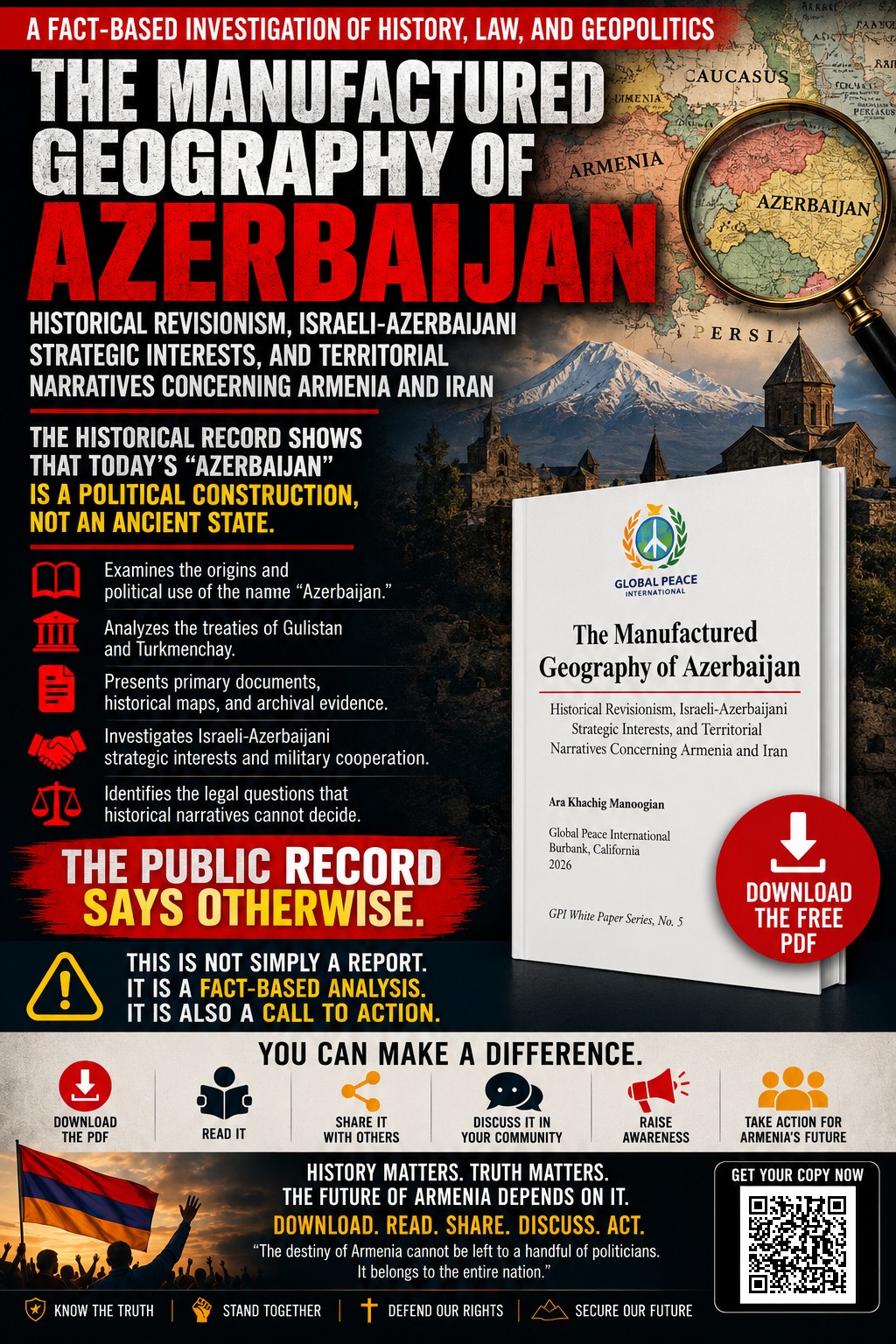
The Manufactured Geography of Azerbaijan
A summary prepared by the author Ara Khachig Manoogian
On October 22, 2026, the Jerusalem Post told its readers that Russian advances in the South Caucasus “split Azerbaijan in two,” and called for a grand alliance of Greece, Cyprus, Israel, Kurdistan, and “a united Azerbaijan.” This paper tests that story against the record: the treaties, the founding declaration, the League of Nations file, the Soviet protocols, and the orders of the International Court of Justice.
Neither the Treaty of Gulistan of 1813 nor the Treaty of Turkmenchay of 1828 calls the lands ceded to Russia “Azerbaijan.” The one time the name appears in either treaty, it refers to the Iranian province south of the Aras. The republic that took the name was proclaimed in Tiflis on May 28, 1918, and Iran objected: the new government used the term “Caucasian Azerbaijan” abroad to calm Iranian concern, and in 1920 Tabriz renamed its own province to separate it from the new state. In December 1920 the League of Nations found that Azerbaijan’s frontiers could not be defined and declined to admit it. The paper carries the same test into the present: Israel’s 69 percent share of Azerbaijan’s major arms imports in 2016–2020, the Silk Way cargo flights into Israel’s Ovda airbase in the days before the September 2023 assault on Artsakh, the disclosure record of Brenda Shaffer, and President Aliyev’s declaration that “present-day Armenia is our land.” A historical name is not a deed to another nation’s territory. Read the paper, and know the record before the next map is drawn.
Use the following link for the PDF version of “The Manufactured Geography of Azerbaijan”
https://globalpeaceinternational.com/assets/papers/manufactured-geography.pdf


Comments