Lesson Number 2 From The Pages Of History
We may not agree with every statement made by an expert, historian, or political analyst. But we can always have a civilized debate, based on the rules of logical reasoning, and contribute to the solid understanding of Armenian history, and how the present challenges can be addressed to build a better future for the Armenian nation.
One source where a reader can find a wealth of information about the historical realities that have shaped and colored the characteristics of The Third Republic is Global Peace International.
You may endorse some or all the views expressed by the author in his publications, but no matter what your verdict is about the issues tackled by the author, his prolific writings remain a valuable resource for a better understanding of the Armenian nation and the geopolitical threats hovering over Armenia today.
Noubar Serabian
=======================================
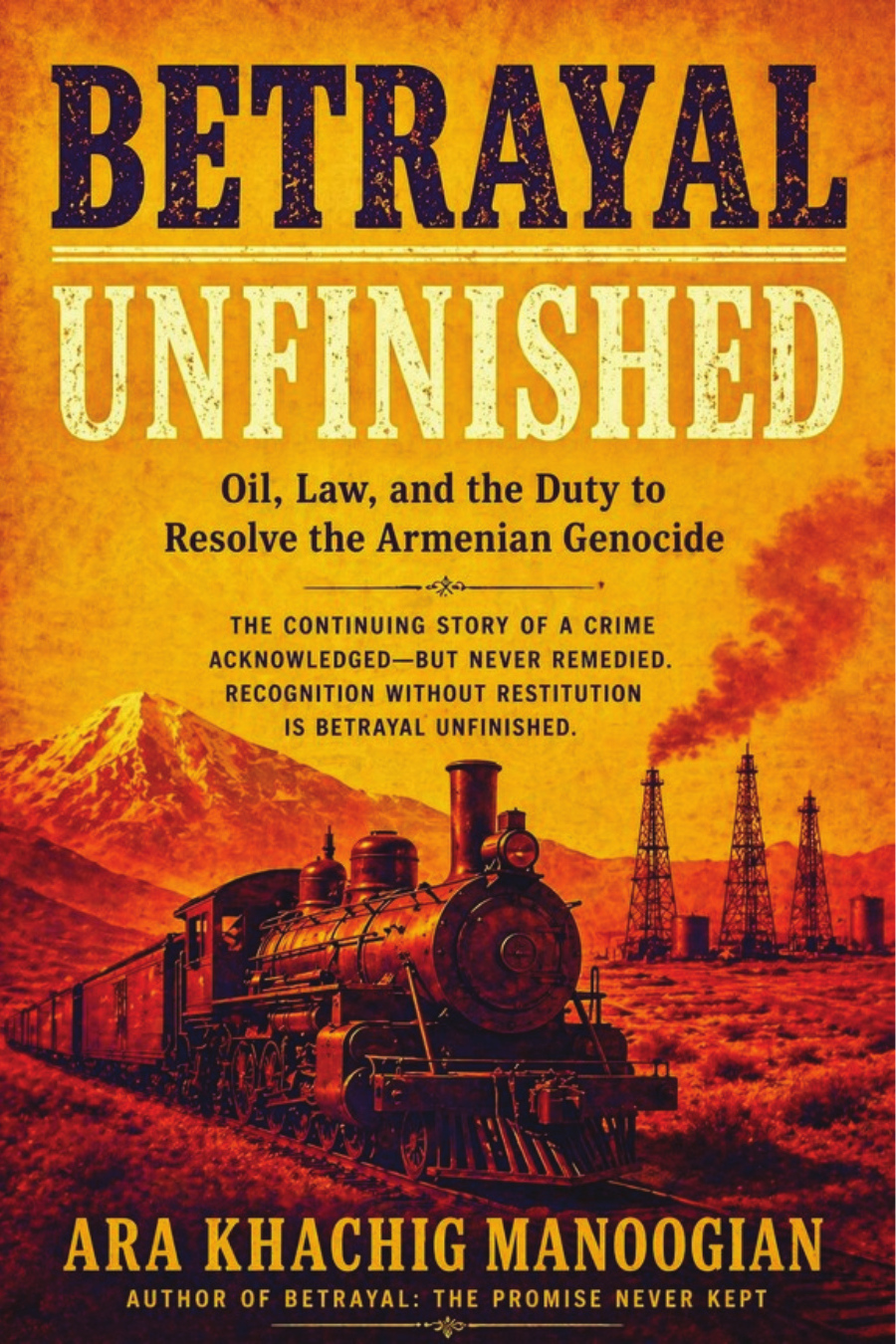
Betrayal Unfinished-Oil, Law, and the Duty to Resolve the Armenian Genocide
By Ara Khachig Manoogian
Betrayal Unfinished is a sweeping work of history, law, and geopolitical analysis that argues the Armenian Genocide is not merely a closed chapter of the past, but an unresolved international issue whose consequences continue into the present day. While many governments and institutions now formally recognize the genocide of Armenians committed between 1915 and 1923, this book asks the question few are willing to confront: What legal, political, and moral obligations follow recognition?
Written by Ara Khachig Manoogian, this volume examines how the destruction and dispossession of the Armenian people reshaped borders, transferred wealth, and altered the balance of power across the Middle East and Caucasus. It explores how lands, industries, churches, homes, and strategic resources once belonging to Armenians were absorbed into successor states and later integrated into global systems of trade, diplomacy, and energy politics.
Through archival evidence, historical case studies, and contemporary legal principles, the book traces the links between genocide and profit. It investigates the role of foreign powers, financiers, oil interests, and postwar diplomacy in allowing the outcomes of atrocity to harden into accepted political reality — from the early twentieth century scramble for oil in Baku and the Armenian Highlands, to Soviet-era border engineering, to the modern conflicts involving Artsakh and regional pipelines.
The work also serves as a practical guide for legislators, policymakers, advocates, and citizens. It explains how international law addresses genocide, occupied territories, pillage of natural resources, sanctions, restitution, and the duty of states not to reward or legitimize the fruits of crimes against humanity.
At once historical indictment and forward-looking policy study, Betrayal Unfinished challenges readers to reconsider the meaning of recognition itself. If genocide has been acknowledged, can the world continue business as usual with those who benefit from its results?
=========================================
Personal Opinion
"War is a brilliantly orchestrated meat grinder where the wealthy elite safely sit in velvet chairs while feeding the sons of the poor into the screaming machinery of death. They call it patriotism, but it is nothing more than a highly profitable, state-sponsored slaughterhouse." Jean-Paul Sartre
More than once I wrote about the fact that wars have hidden dimensions that are not revealed to those who are making the ultimate sacrifice on the battlefields, where armies confront each other with the clear goal of vanquishing the enemy. I explained with concrete examples why “Wars Are Financial Investments.”
Of course, I am not the only person promoting the argument that wars are masterminded by multi national corporations, financiers, and bankers who often extend loans to all the warring parties interested in looting the natural wealth of a region. For a solid testimony of the facts stated, I strongly encourage readers to consult an essay titled “War Is A Racket” written by Major General Smedley D. Butler, the most decorated Marine in U.S. history, who described himself as a "high-class muscle man for Big Business" and a "racketeer for capitalism."
Two paragraphs from chapter one of “War Is A Racket:”
"War is a racket. It always has been. It is possibly the oldest, easily the most profitable, surely the most vicious. It is the only one international in scope. It is the only one in which the profits are reckoned in dollars and the losses in lives.
A racket is best described, I believe, as something that is not what it seems to the majority of people. Only a small "inside" group knows what it is about. It is conducted for the benefit of the very few, at the expense of the very many. Out of war a few corporations make huge fortunes."


Comments