Lessons From The Pages Of History
We may not agree with every statement made by an expert, historian, or political analyst. But we can always have a civilized debate, based on the rules of logical reasoning, and contribute to the solid understanding of Armenian history, and how the present challenges can be addressed to build a better future for the Armenian nation.
One source where a reader can find a wealth of information about the historical realities that have shaped and colored the characteristics of The Third Republic is Global Peace International.
You may endorse some or all the views expressed by the author in his publications, but no matter what your verdict is about the issues tackled by the author, his prolific writings remain a valuable resource for a better understanding of the Armenian nation and the geopolitical threats hovering over Armenia today.
Noubar Serabian
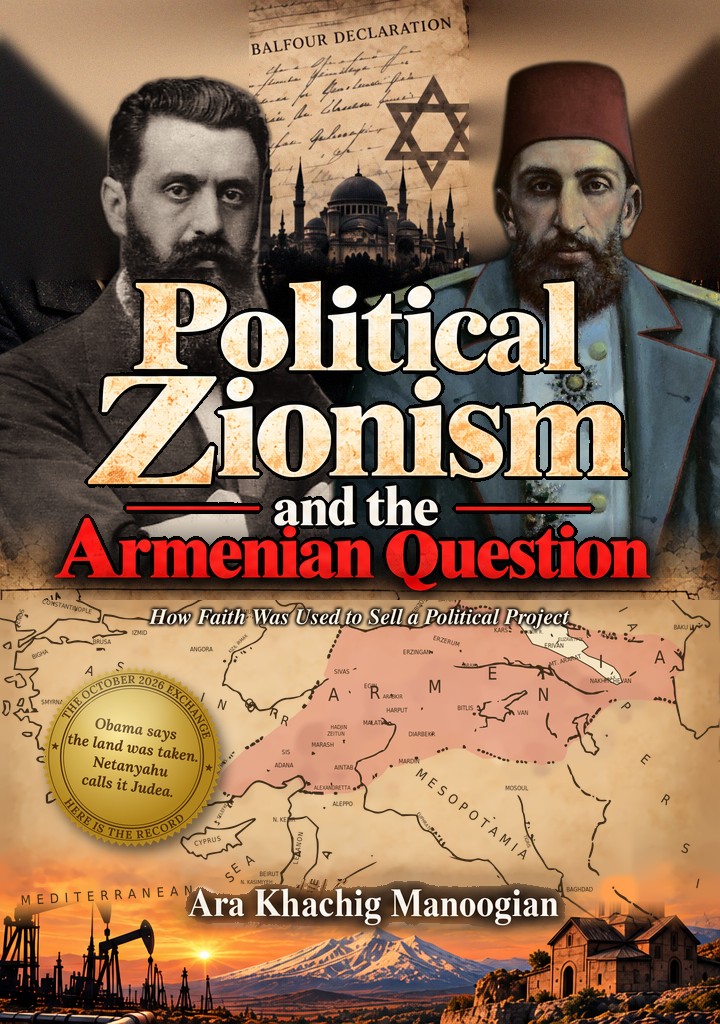
The book arrives in the middle of a public argument over its subject. Speaking in Belfast on October 13, former President Barack Obama said Israel “took land off people” and had “ceded moral ground.” Three days later, Prime Minister Benjamin Netanyahu answered that “our land is not stolen land” and called it by its biblical name, Judea. Political Zionism and the Armenian Question is the record behind that exchange.
Drawing on the founders’ own diaries, government archives, court rulings, and ship-tracking records, the book follows the story from the Protestant statesmen and preachers of nineteenth-century England and America, who called for the return of the Jews to Palestine decades before most Jews did, through Theodor Herzl’s 1896 offer to help the Ottoman sultan against the Armenians, to the Israeli weapons that armed Azerbaijan’s assault on Artsakh. Along the way it follows the money and oil that moved alongside the sermons.
This is not a book about Judaism or the Jewish people. It is an investigation into a political movement, the state it built, and the consequences for Armenians, for Palestinians, Syrians, Lebanese, and the other peoples of the region, and for believers of every faith whose devotion has been used for someone else’s gain.
“This is not a book against Jews, Christians, or Muslims. It is written for them, for the believers whose sincere devotion is being used for someone else’s gain. It asks every reader one question: when your faith is used to send others to war, who benefits?”
The book includes full footnotes, original documents, a chronology, and an index. It closes with what the law already requires and what citizens can do to make their governments honor it.
Political Zionism and the Armenian Question (ISBN 978-1-950801-16-9) is available now in paperback ($35.00) and eBook ($11.99) from the GPI bookstore and through Books.by.


Comments